
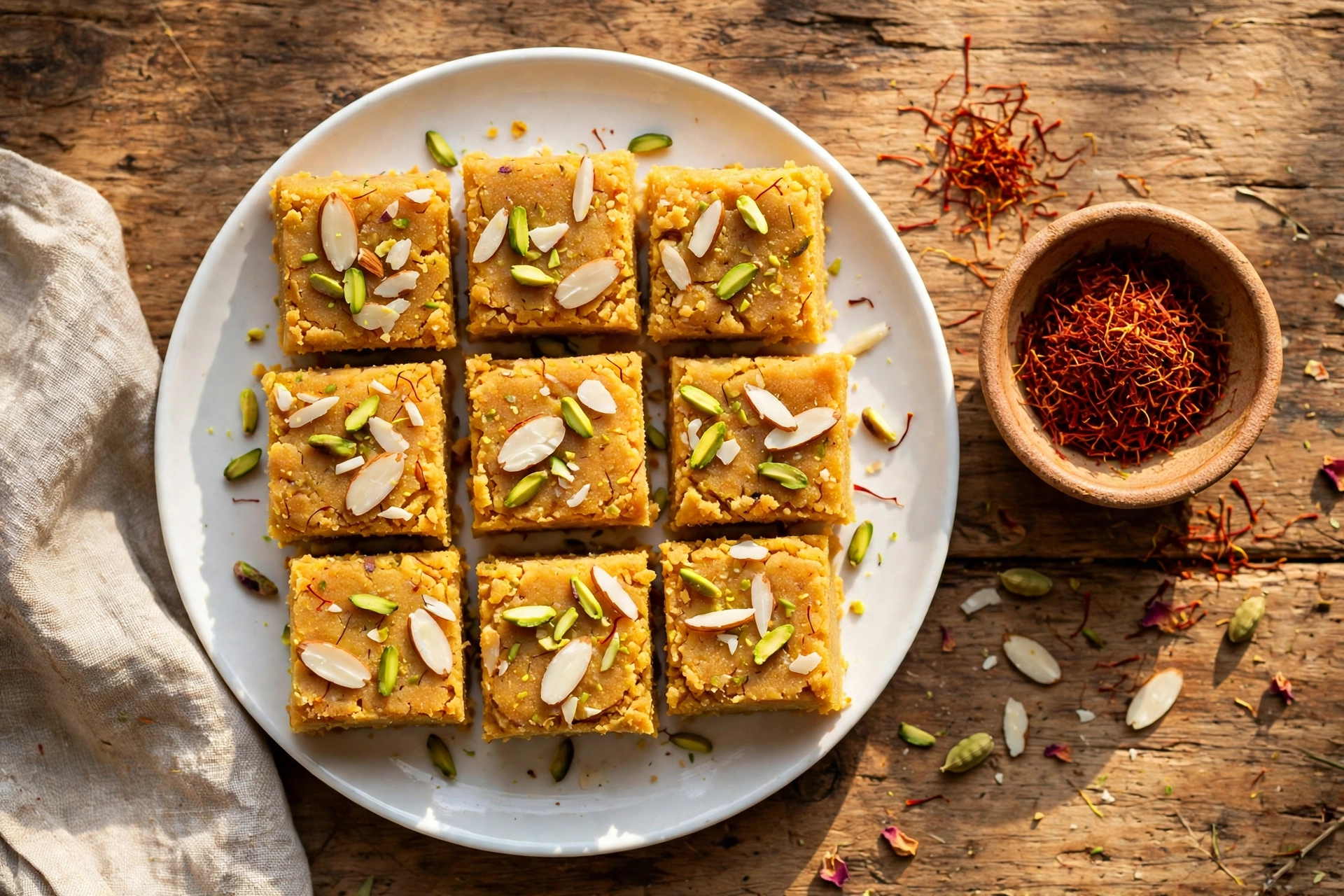
Mohanthal is one of Gujarat’s most loved traditional sweets. It is made from gram flour (besan) roasted slowly in ghee until golden, then set with sugar syrup and flavoured with cardamom, saffron, and nuts. It tastes rich, nutty, and melt-in-the-mouth, with a soft, fudge-like texture.
This recipe works because the besan is roasted on a low flame until it smells nutty and turns golden — that slow roasting is the whole secret of mohanthal. It is a good recipe for Diwali, for festivals, for prasad, and for gifting. It keeps well for two weeks, so you can make it ahead of time.
Mohanthal
Equipment
- Heavy kadai
Ingredients
- 2 cups Gram flour besan (240 g)
- 1 cup Ghee 225 g, plus 1 tablespoon for greasing
- 1 cup Sugar 200 g
- 1/2 cup Water 120 ml
- 2 tablespoons Milk
- 1/2 teaspoon Cardamom powder
- 1 pinch Saffron strands soaked in 1 tablespoon warm milk
- 2 tablespoons Sliced almonds for garnish
- 2 tablespoons Sliced pistachios for garnish
Instructions
- Rub 2 tablespoons of ghee and milk into the besan and rest it 10 minutes.
- Sieve the besan to get a coarse, grainy texture.
- Roast the besan in ghee on low flame for 20–25 minutes until golden and nutty.
- Make a one-string sugar syrup with water, then add saffron and cardamom.
- Mix the syrup into the roasted besan quickly and pour into a greased tray.
- Garnish with nuts, cool for 2 hours, and cut into squares.
Notes
Ingredients
| Ingredient | Quantity |
|---|---|
| Gram flour (besan) | 2 cups (240 g) |
| Ghee | 1 cup (225 g) |
| Sugar | 1 cup (200 g) |
| Water | 1/2 cup (120 ml) |
| Milk | 2 tablespoons |
| Cardamom powder | 1/2 teaspoon |
| Saffron strands | A pinch |
| Sliced almonds (for garnish) | 2 tablespoons |
| Sliced pistachios (for garnish) | 2 tablespoons |
Optional ingredients: 1 tablespoon of desiccated coconut on top, a pinch of nutmeg powder, 1 teaspoon of rose water in the syrup.
How to Make Mohanthal
Step 1: Prepare the Besan
Take the gram flour in a wide bowl. Add 2 tablespoons of ghee and 2 tablespoons of milk, and rub them into the flour with your fingertips until it looks like coarse breadcrumbs. Cover and rest for 10 minutes. Then press the mixture through a coarse sieve or a colander to break it into small, even grains — this grainy texture is what makes mohanthal soft, not pasty.
Step 2: Roast the Besan in Ghee
Heat the remaining ghee in a heavy kadai on low flame. Add the sieved besan and roast slowly, stirring continuously, for 20–25 minutes. The besan will first look dry, then slowly turn golden and smell nutty, and the ghee will start to separate at the edges. Do not rush this step — low flame and patience are what make good mohanthal.
Step 3: Make the Sugar Syrup
While the besan roasts, make the syrup in a separate pan. Add sugar and water, and cook on medium flame, stirring until the sugar dissolves. Cook for 3–4 minutes until it reaches one-string consistency — take a drop between your thumb and finger, and it should form one thin thread. Add the saffron soaked in warm milk and the cardamom powder, and turn off the flame.
Step 4: Mix and Set
Turn off the flame under the roasted besan. Pour the hot syrup into the besan in a thin stream, mixing quickly with a spatula. The mixture will thicken fast. Pour it at once into a greased tray or thali, and spread it evenly to about 1 inch thickness. Sprinkle the sliced almonds and pistachios on top and press them in gently.
Step 5: Cool and Cut
Let the mohanthal cool at room temperature for 2 hours, until it is fully set but not hard. Cut it into squares or diamonds with a greased knife. Lift the pieces carefully and store them in an airtight container.
What is Mohanthal?
Mohanthal is a traditional Gujarati sweet made for Diwali, weddings, and temple prasad. Its name comes from “mohan” — Lord Krishna — and it is said to be one of his favourite sweets. It is made in almost every Gujarati home during Diwali, and it is also sold in sweet shops across Gujarat all year round. The best mohanthal is soft, grainy, and rich with ghee — never hard or dry.
Tips for Perfect Mohanthal
- Use coarse besan (ladoo besan) if you can find it. Fine besan makes mohanthal pasty instead of grainy.
- Roast on low flame only. High flame burns the besan in minutes, and burnt besan tastes bitter and cannot be fixed.
- Stir continuously while roasting. The besan at the bottom burns first, so keep it moving.
- Get the syrup right. One-string consistency is the key — a thin syrup makes soft mohanthal that does not set, and a thick syrup makes it hard and dry.
- Mix fast once the syrup goes in. The mixture sets quickly, so have the greased tray ready before you pour.
- Add saffron for colour and flavour. A pinch soaked in warm milk gives a beautiful golden colour and a festive taste.
- Cut only when fully set. Cutting too early crumbles the pieces; cutting too late cracks them.
Variations
Chocolate Mohanthal: Add 2 tablespoons of cocoa powder to the roasted besan before adding the syrup, for a modern twist children love.
Coconut Mohanthal: Mix 3 tablespoons of desiccated coconut into the roasted besan for extra texture and flavour.
Dry Fruit Mohanthal: Add chopped cashews, raisins, and pistachios to the besan while roasting, and garnish with more nuts.
Jaggery Mohanthal: Replace the sugar with the same amount of jaggery for a deeper, caramel-like sweetness.
Low-Sugar Mohanthal: Reduce the sugar to 3/4 cup. The sweet will be softer and milder, and it will need a little longer to set.
What to Serve with Mohanthal
Serve mohanthal with:
- Masala chai, after a meal or at tea-time
- A Gujarati thali, as the sweet at the end of the meal
- Laapsi — another traditional Gujarati sweet for festivals
- Khajur Paak — a winter Gujarati sweet, good with mohanthal on a sweet platter
- Thepla — for a sweet-and-savoury tea-time plate
- As prasad, or packed in a box as a gift for Diwali
Storage Tips
- Room temperature: Store in an airtight container for up to 2 weeks. Keep it away from moisture.
- Fridge: Keeps for up to 3 weeks in the fridge. Bring to room temperature before serving — cold mohanthal is hard.
- Freezer: Freeze in an airtight box for up to 2 months. Thaw in the fridge overnight.
- Reheating: No reheating needed. Serve at room temperature. Warming it in the microwave makes it soft and oily.
Nutrition
| Nutrient | Amount (approx. per piece) |
|---|---|
| Calories | 220 kcal |
| Protein | 4 g |
| Carbohydrates | 26 g |
| Fat | 12 g |
| Fibre | 2 g |
Mohanthal is a festive sweet — rich in ghee and sugar, so it is an occasional treat, not an everyday food. Gram flour gives it protein and fibre, and the nuts on top add healthy fats. One piece after a meal is the traditional way to enjoy it.
Frequently Asked Questions (FAQs)
1. Why is my mohanthal hard?
The sugar syrup was cooked too long, past one-string consistency, or the besan was roasted too much. Cook the syrup only until one thin thread forms, and keep the flame low while roasting.
2. Why is my mohanthal soft and not setting?
The syrup was too thin, or too little sugar was used. Cook the syrup to one-string consistency and let the mohanthal set for a full 2 hours at room temperature.
3. Why does my mohanthal taste bitter?
The besan was roasted on too high a flame and burned. Roast only on low flame, stir continuously, and take it off the heat as soon as it turns golden and smells nutty.
4. Can I make mohanthal without ghee?
Ghee is what gives mohanthal its flavour and texture, so it is hard to replace. You can use half ghee and half neutral oil in a hurry, but the taste will be lighter and less rich.
5. What is one-string consistency?
Take a drop of hot syrup between your thumb and index finger and pull them apart slowly. If one thin thread forms and breaks, it is one-string consistency. If no thread forms, cook a little longer.
6. Can I make mohanthal in advance for Diwali?
Yes, it is perfect for making ahead. It keeps for 2 weeks at room temperature and 3 weeks in the fridge, so make it a few days before the festival.
7. Is mohanthal gluten-free?
Yes, it is naturally gluten-free — it is made from gram flour, ghee, sugar, and nuts. Just check that your asafoetida is not used here (this recipe does not need it).
8. Why is my mohanthal grainy in a bad way?
The besan was not sieved after rubbing in ghee and milk, or the grains were uneven. Sieve the besan mixture properly before roasting — even grains make a soft, even texture.
Conclusion
Mohanthal is Gujarat’s classic festive sweet — golden, nutty, and rich with ghee, with a soft texture that melts in your mouth. It needs patience, not skill: roast slowly, get the syrup right, and let it set. Try this recipe for Diwali or for a family function, and enjoy a sweet that has been loved in Gujarati homes for generations.
About the Author
Vaishali Soni loves cooking traditional Gujarati food at home and sharing tested, step-by-step recipes that work for beginners. She writes Gujarati Food Recipes with Beena Soni. Try this recipe and tell us in the comments how it turned out.