
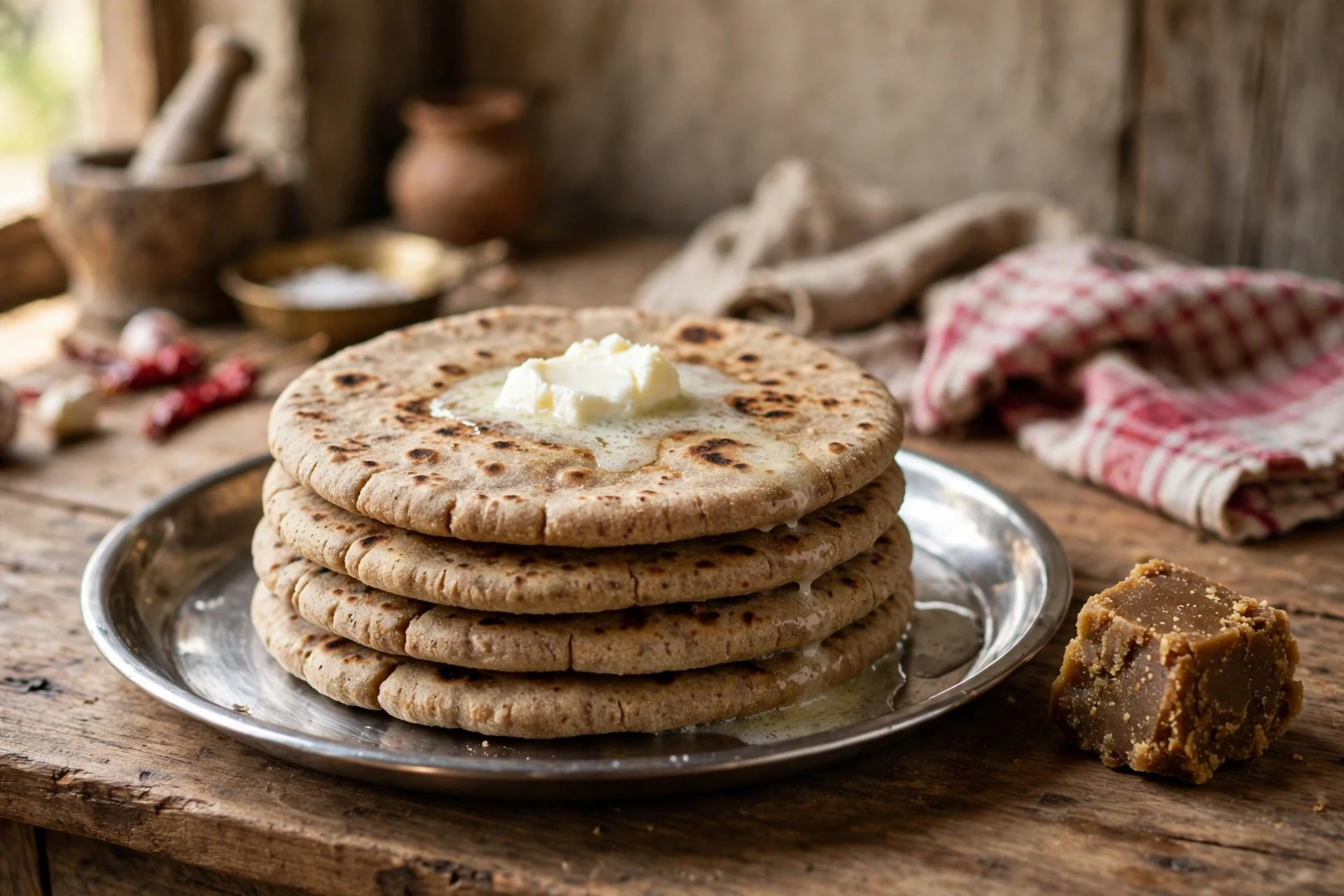
Jowar rotla is a thick, soft flatbread made from sorghum flour (jowar atta), a staple of Gujarati winter meals. It is pressed by hand, not rolled, and roasted on a hot tawa until it puffs up. It tastes nutty and earthy, and it is served hot with a dollop of white butter, a piece of jaggery, and a bowl of undhiyu or a simple shaak.
This recipe works because the dough is kneaded with hot water, which softens the sorghum flour and makes it easy to press without cracking. It needs no rolling pin and no oil, and it is naturally gluten-free. It is perfect for anyone who wants a wholesome, filling flatbread with their winter curry.
Jowar Rotla
Ingredients
- 2 cups Jowar flour sorghum flour, 240 g
- 1 cup Hot water 240 ml approx.
- 1/2 teaspoon Salt
- Ghee or white butter for serving, 1–2 teaspoons per rotla
- Jaggery for serving, optional, a small piece per rotla
Instructions
- Mix jowar flour and salt, then add hot water a little at a time and knead into a soft dough.
- Rest the dough for 10 minutes, then divide into 6 equal balls.
- Flatten each ball by hand on a floured surface, pressing from the centre outwards into a round about 6 inches wide.
- Place on a hot tawa and cook on medium flame until brown spots appear, then flip.
- Press gently with a cloth until the rotla puffs up, then cook the other side.
- Serve hot with white butter and jaggery.
Notes
Ingredients
| Ingredient | Quantity |
|---|---|
| Jowar flour (sorghum flour) | 2 cups (240 g) |
| Hot water | 1 cup (240 ml) approx. |
| Salt | 1/2 teaspoon |
| Ghee or white butter (for serving) | 1–2 teaspoons per rotla |
| Jaggery (for serving, optional) | A small piece per rotla |
Optional ingredients: 1 tablespoon of sesame seeds mixed into the dough, a pinch of ajwain (carom seeds) for flavour, 2 tablespoons of finely chopped methi leaves for a methi rotla.
How to Make Jowar Rotla
Step 1: Make the Dough
Take jowar flour in a large bowl and add salt. Boil water and pour it in a little at a time, mixing with a spoon at first because it is hot. When it is cool enough to touch, knead with your hands for 3–4 minutes until the dough is soft and smooth. If it feels dry, add a spoon of hot water. If it feels sticky, add a spoon of flour.
Step 2: Rest the Dough
Cover the dough with a damp cloth and rest it for 10 minutes. This rest lets the flour absorb the water fully, so the rotla does not crack while pressing.
Step 3: Divide into Balls
Divide the dough into 6 equal portions and roll each one into a smooth ball. Keep the balls covered with the damp cloth so they do not dry out.
Step 4: Press by Hand
Take one ball and dust it lightly with dry jowar flour. Place it on a flat board or on your palm and press gently with your fingers, working from the centre outwards. Turn it as you press so it stays round. Aim for a circle about 6 inches wide and a little thicker than a roti. Do not use a rolling pin — jowar dough cracks under a rolling pin.
Step 5: Cook on the Tawa
Heat a tawa on medium flame. Place the rotla on it and cook for about 1 minute, until small brown spots appear on the underside. Flip it over and cook the other side for 1 minute. Then press the edges gently with a folded cloth — the rotla should puff up like a balloon. Cook for 30 seconds more, then take it off the flame.
Step 6: Serve Hot
Spread a little ghee or white butter on the hot rotla and serve at once with a piece of jaggery on the side. Keep the cooked rotlas wrapped in a clean cloth so they stay soft until serving.
What is Jowar Rotla?
Jowar rotla is the winter flatbread of Gujarat and Maharashtra, made from sorghum, a grain that grows well in dry regions and keeps the body warm in cold weather. Unlike wheat roti, it is pressed by hand and cooked a little thicker, so it stays soft inside. In Gujarati homes it is the first thing that comes to mind with undhiyu — the two are inseparable in winter.
Tips for Perfect Jowar Rotla
- Use hot water, always. Cold water gives a stiff dough that cracks the moment you press it.
- Knead well. A smooth, soft dough is the whole secret — under-kneaded dough falls apart on the tawa.
- Press, do not roll. A rolling pin tears jowar dough. Your palm and fingers are the right tools.
- Keep the flame medium. Too hot and the rotla burns outside while staying raw inside; too low and it dries out.
- Dust lightly with flour. Too much dry flour on the surface makes the rotla hard.
- Press gently to puff it. A light press with a cloth at the end puffs the rotla up and cooks it through.
- Serve immediately. Jowar rotla is at its best hot off the tawa, with melting butter.
Variations
Methi Jowar Rotla: Mix 2 tablespoons of finely chopped methi (fenugreek) leaves into the dough. It adds a gentle bitterness that goes well with jaggery and butter.
Sesame Jowar Rotla: Add 1 tablespoon of sesame seeds to the dough for a nutty crunch.
Ajwain Jowar Rotla: Add 1/2 teaspoon of ajwain to the dough — good for digestion and a lovely flavour with undhiyu.
Garlic Jowar Rotla: Mix 1 teaspoon of grated garlic and a pinch of red chilli powder into the dough for a spicy version.
Mixed Flour Rotla: Use 1 cup jowar flour and 1 cup bajra flour for a rotla that is softer and easier to press — a good choice for beginners.
What to Serve with Jowar Rotla
Serve jowar rotla with:
- Undhiyu — the classic winter pairing
- Bajra Rotla — serve both rotlas together for a winter thali
- Gujarati Kadhi — pour a little kadhi over the rotla, the way it is eaten in villages
- Sev Tameta Shaak — a quick, tangy curry that goes well with rotla
- Ringan bateta nu shaak — brinjal-potato curry, another winter favourite
- White butter and jaggery — the simplest and most loved way to eat it
Storage Tips
- Room temperature: Best eaten fresh and hot. Keep wrapped in a cloth for up to 4–5 hours.
- Fridge: Store in an airtight container for up to 1 day. Jowar rotla hardens in the fridge, so this is not the best option.
- Freezer: Freeze the cooked rotlas in a zip-lock bag for up to 1 month. Reheat on a tawa with a little ghee.
- Reheating: Warm on a hot tawa for 30 seconds on each side, or sprinkle a few drops of water and warm in a pan. Do not microwave for long, or it turns chewy.
Nutrition
| Nutrient | Amount (approx. per rotla) |
|---|---|
| Calories | 150 kcal |
| Protein | 4 g |
| Carbohydrates | 30 g |
| Fat | 2 g |
| Fibre | 5 g |
Jowar is a whole grain rich in fibre, iron, and protein, and it is naturally gluten-free, so it suits people who cannot eat wheat. It digests slowly, which keeps you full for longer, and it is a good source of energy on cold winter days. Eaten with butter and jaggery, it is a complete, satisfying meal on its own.
Frequently Asked Questions (FAQs)
1. Why does my jowar rotla crack while pressing?
The dough was made with cold water, or it was not kneaded enough. Always use hot water and knead until the dough is soft and smooth. Resting the dough for 10 minutes also helps a lot.
2. Can I roll jowar rotla with a rolling pin?
It is not recommended. Jowar flour has no gluten, so the dough tears under a rolling pin. Press it by hand — it is easier than it looks, and it gets better with practice.
3. Is jowar rotla gluten-free?
Yes. Jowar (sorghum) is naturally gluten-free. Just make sure your flour is not mixed with wheat flour — buy pure jowar atta.
4. Why does my rotla not puff up?
The flame may be too low, or the dough may be too thick. Press the rotla evenly so it is the same thickness all over, keep the tawa on medium flame, and press the edges gently with a cloth to help it puff.
5. Can I make the dough in advance?
Yes, for a few hours. Keep it covered with a damp cloth at room temperature. Do not refrigerate the dough — it turns hard and cracks when pressed.
6. What is the difference between jowar rotla and bajra rotla?
Both are hand-pressed winter flatbreads, but jowar rotla is lighter in colour and milder in taste, while bajra rotla is darker, denser, and more filling. Jowar rotla is easier to press, so it is a good first rotla to learn.
7. Can I cook jowar rotla on a gas flame directly?
Yes, like a phulka. After cooking both sides on the tawa, hold the rotla with tongs over an open flame for a few seconds until it puffs. Be careful not to burn it.
8. Is jowar rotla good for weight loss?
Jowar is high in fibre and keeps you full for a long time, which can help with portion control. One rotla with a vegetable curry and no extra butter is a light, filling meal. Skip the extra ghee if you are watching calories.
Conclusion
Jowar rotla is simple food at its best — one flour, hot water, salt, and your hands. It takes a little practice to press, but once you get it, you will make it all winter. Serve it hot with undhiyu, butter, and jaggery, and tell us how your first rotla turned out.
About the Author
Vaishali Soni loves cooking traditional Gujarati food at home and sharing tested, step-by-step recipes that work for beginners. She writes Gujarati Food Recipes with Beena Soni. Try this recipe and tell us in the comments how it turned out.