
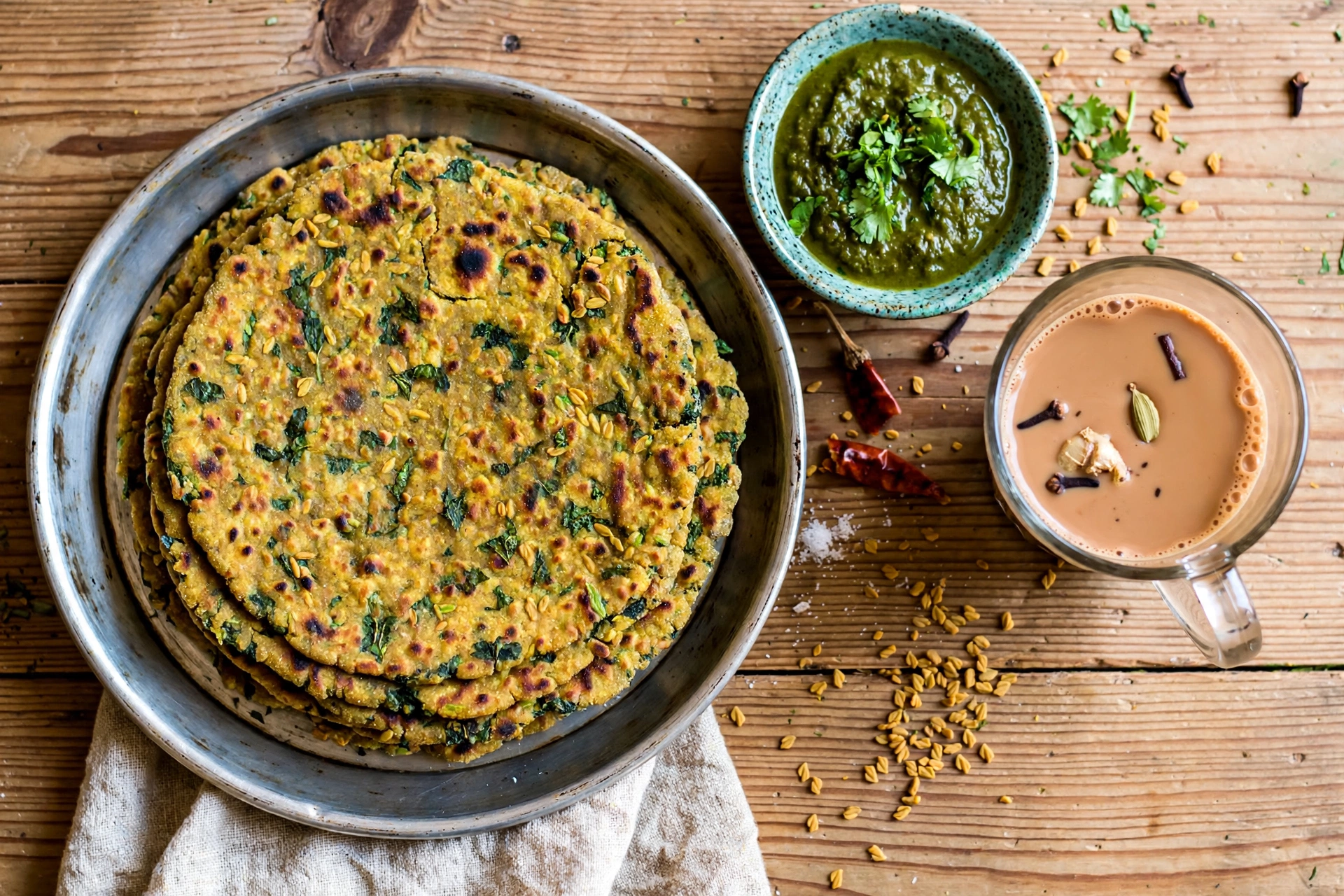
Dhebra is a crisp, flavourful Gujarati flatbread made with bajra (pearl millet) flour, wheat flour, and fresh methi (fenugreek) leaves, kneaded with curd and spices and fried until golden. It tastes nutty from the bajra, lightly bitter from the methi, and gently sweet from a little jaggery — a combination that is pure winter Gujarat. Dhebra is eaten for breakfast, packed into lunchboxes, and carried on train journeys because it stays fresh for days.
This recipe works because the dough is kneaded stiff with curd instead of water, which keeps the dhebra soft inside and crisp outside, and because the methi is mixed right into the flour so every bite is flavoured. It is easy to make, needs no fermentation, and is a wonderful way to use fresh methi in winter. It is perfect for beginners, for busy mornings, and for anyone who wants a wholesome, travel-friendly breakfast.
Dhebra
Ingredients
- 2 cups Bajra (pearl millet) flour 240 g
- 1 cup Whole wheat flour 120 g
- 1 cup Fresh methi (fenugreek) leaves chopped, 30 g
- 1/2 cup Curd 120 g
- 1 tablespoon Jaggery grated
- 2 Green chillies finely chopped
- 1 teaspoon Ginger grated
- 1 tablespoon Sesame seeds
- 1/2 teaspoon Ajwain (carom seeds)
- 1/2 teaspoon Turmeric powder
- 1 teaspoon Red chilli powder
- 1 teaspoon Coriander powder
- Salt to taste
- 2 tablespoons Oil for the dough
- Oil for frying, as needed
- Water as needed
Instructions
- Mix bajra flour, wheat flour, methi leaves, and all the spices in a large bowl.
- Add curd, jaggery, and 2 tablespoons of oil, and knead into a stiff dough, adding a little water only if needed.
- Cover and rest the dough for 30 minutes.
- Divide into 12 balls and roll each into a 4-inch circle.
- Deep-fry or shallow-fry in hot oil until golden and crisp on both sides.
- Drain on paper and serve hot or at room temperature.
Notes
Ingredients
| Ingredient | Quantity |
|---|---|
| Bajra (pearl millet) flour | 2 cups (240 g) |
| Whole wheat flour | 1 cup (120 g) |
| Fresh methi (fenugreek) leaves | 1 cup chopped (30 g) |
| Curd | 1/2 cup (120 g) |
| Jaggery | 1 tablespoon, grated |
| Green chillies | 2, finely chopped |
| Ginger | 1 teaspoon, grated |
| Sesame seeds | 1 tablespoon |
| Ajwain (carom seeds) | 1/2 teaspoon |
| Turmeric powder | 1/2 teaspoon |
| Red chilli powder | 1 teaspoon |
| Coriander powder | 1 teaspoon |
| Salt | To taste |
| Oil (for the dough) | 2 tablespoons |
| Oil (for frying) | As needed |
| Water | As needed, a few tablespoons only |
Optional ingredients: 1 tablespoon of crushed peanuts for extra crunch, 1/2 teaspoon of crushed black pepper for a sharper taste, a pinch of hing (asafoetida) in the dough.
How to Make Dhebra
Step 1: Prepare the Methi
Pick the methi leaves, discarding thick stems. Wash them well in 2–3 changes of water, drain, and chop finely. If the leaves taste very bitter, sprinkle a little salt over them, rest for 10 minutes, and squeeze out the water before using.
Step 2: Mix the Flours and Spices
In a large bowl, combine the bajra flour and whole wheat flour. Add the chopped methi, green chillies, ginger, sesame seeds, ajwain, turmeric powder, red chilli powder, coriander powder, and salt. Mix everything well with your fingers so the methi and spices are spread evenly through the flour.
Step 3: Knead a Stiff Dough
Add the curd, grated jaggery, and 2 tablespoons of oil to the flour. Mix and knead into a stiff dough, adding water only a tablespoon at a time if the dough will not come together. The dough should be firm, like puri dough — not soft like roti dough. Cover with a damp cloth and rest for 30 minutes.
Step 4: Roll the Dhebra
Divide the dough into 12 equal balls. Lightly grease your palms and the rolling surface with oil (do not use dry flour for dusting, or the dhebra will not puff well). Roll each ball into a circle about 4 inches across and a little thicker than a puri. Prick the centre once or twice with a fork so it does not puff up too much while frying.
Step 5: Fry Until Golden
Heat oil in a kadhai on a medium flame. To test it, drop a tiny piece of dough in — it should rise to the surface slowly, not at once. Slide in 2–3 dhebra at a time. Fry for about 2 minutes on each side, pressing gently with a slotted spoon, until both sides are golden brown and crisp. Drain on kitchen paper.
Step 6: Serve
Serve the dhebra hot with green chutney and masala chai, or let them cool and pack them for a lunchbox or a journey. They stay crisp for hours and taste just as good at room temperature.
What is Dhebra?
Dhebra is a traditional winter flatbread from Gujarat, made when fresh methi and bajra are both in season. Unlike thepla, which is a soft roti cooked on a tawa, dhebra is rolled thicker and fried, so it turns crisp and keeps for days without refrigeration. In Gujarati homes it is a travel food — mothers pack stacks of dhebra with pickle and thepla for long train journeys — and a winter breakfast, eaten hot with tea. The combination of bajra and methi is also a classic winter pairing in Gujarat: both are warming foods, eaten through the cold months.
Tips for Perfect Dhebra
- Use fresh methi leaves. Old, yellowing methi tastes bitter and will spoil the dhebra.
- Knead a stiff dough. Soft dough absorbs too much oil and makes soggy dhebra.
- Rest the dough for the full 30 minutes. Bajra flour needs time to soak up the moisture, or the dhebra will crack while rolling.
- Roll with oil, not flour. Dry flour on the surface burns in the hot oil and leaves dark spots.
- Fry on a medium flame. High heat browns the outside while the inside stays raw; low heat makes the dhebra drink oil.
- Do not roll the dhebra too thin. A thin dhebra turns hard like a cracker instead of crisp outside and soft inside.
- Add the jaggery even if you like savoury food. Just one tablespoon balances the bitterness of the methi and the earthiness of the bajra.
Variations
Bajra-Only Dhebra: Skip the wheat flour and use 3 cups of bajra flour with a little extra curd. The dhebra will be more crumbly and more rustic — handle the dough gently while rolling.
Shallow-Fried Dhebra: Instead of deep-frying, cook the rolled dhebra on a tawa with 1–2 teaspoons of oil, like a thepla. It is lighter and less crisp, but much lower in oil.
Jain Dhebra: Skip the ginger. The rest of the recipe stays the same, and the methi and ajwain still give plenty of flavour.
Spicy Dhebra: Add 1 more green chilli and 1/2 teaspoon of crushed black pepper. Serve with plain curd to cool the heat.
Kids’ Dhebra: Leave out the green chillies and red chilli powder, and add a little more jaggery. The mild, sweet version is usually a hit with children.
What to Serve with Dhebra
Serve dhebra with:
- Green chutney — the classic fresh, spicy partner
- Masala chai — hot, milky, and spiced, the way dhebra is eaten on winter mornings
- Plain curd or raita — a cool contrast to the crisp, spiced flatbread
- Thepla — serve both together for a Gujarati breakfast spread
- Bajra Rotla — another bajra favourite for a winter meal
- Mango pickle or garlic chutney — for a sharp, tangy bite
Storage Tips
- Room temperature: Store cooled dhebra in an airtight container for 3–4 days. This is why it is a travel food — it keeps without a fridge.
- Fridge: Not needed. If you do refrigerate, the dhebra will lose its crispness.
- Freezer: The raw dough freezes well for up to 1 month. Thaw, roll, and fry fresh. Fried dhebra does not freeze well.
- Reheating: Warm on a tawa on a low flame for 1 minute on each side, or in a hot oven for 3–4 minutes. Avoid the microwave — it makes them soft.
Nutrition
| Nutrient | Amount (approx. per serving) |
|---|---|
| Calories | 210 kcal |
| Protein | 6 g |
| Carbohydrates | 32 g |
| Fat | 7 g |
| Fibre | 5 g |
Dhebra is made from whole-grain bajra, which is rich in fibre and iron, and fresh methi, which adds vitamins and a gentle bitterness that aids digestion. The curd in the dough adds a little protein and keeps the flatbread soft inside. It is a filling, slow-energy breakfast that keeps you full for hours.
Frequently Asked Questions (FAQs)
1. What is the difference between dhebra and thepla?
Thepla is a soft flatbread cooked on a tawa with very little oil, while dhebra is rolled thicker and fried in oil, so it turns crisp and keeps for days. Dhebra always uses bajra flour and methi; thepla is usually wheat flour and can be made with many different greens. Try our Thepla recipe to taste the difference.
2. Why is my dhebra hard instead of crisp?
The dough was kneaded too soft, or the dhebra was rolled too thin, or fried on too high a flame. Keep the dough stiff, roll it a little thick, and fry on medium heat.
3. Can I make dhebra without methi?
Yes, but then it is really a bajra puri, not a dhebra. You can use chopped spinach or coriander leaves instead, but the classic winter taste comes from methi.
4. Is dhebra gluten-free?
Not in this recipe, because it uses whole wheat flour along with the bajra. For a gluten-free version, use only bajra flour and a little more curd, and roll the dough between two greased sheets of plastic.
5. Can I bake dhebra instead of frying?
Yes. Brush the rolled dhebra with oil and bake at 200°C (400°F) for 10–12 minutes, flipping once. They will be crisp but lighter than the fried version.
6. How long does dhebra stay fresh?
3–4 days in an airtight container at room temperature. That is why it is packed for journeys — it travels better than almost any other Gujarati snack.
7. Why does my dhebra crack while rolling?
The dough was too dry or not rested long enough. Bajra flour needs the full 30-minute rest to absorb moisture. Add a teaspoon of curd and knead again if it still cracks.
8. Can I make dhebra ahead for a journey?
Yes, that is what it is made for. Fry the dhebra, cool them completely, and pack in an airtight box with pickle in a separate small container so the pickle does not make them soft.
9. Is dhebra healthy?
It is made from whole bajra, fresh methi, and curd, so it is rich in fibre and iron. The deep-fried version is higher in fat — shallow-fry or bake it if you want a lighter dhebra.
10. What do you eat dhebra with?
Green chutney and masala chai are the classic partners. It also goes well with curd, pickle, and a simple potato shaak.
Conclusion
Dhebra is winter Gujarat in a flatbread — crisp, nutty, warming, and made to travel. The bajra and methi do the heavy lifting, the curd keeps it soft inside, and one batch feeds the whole family for days. Make it on a cold morning, eat it hot with chai, and pack the rest for the road.
About the Author
Vaishali Soni loves cooking traditional Gujarati food at home and sharing tested, step-by-step recipes that work for beginners. She writes Gujarati Food Recipes with Beena Soni. Try this recipe and tell us in the comments how it turned out.