
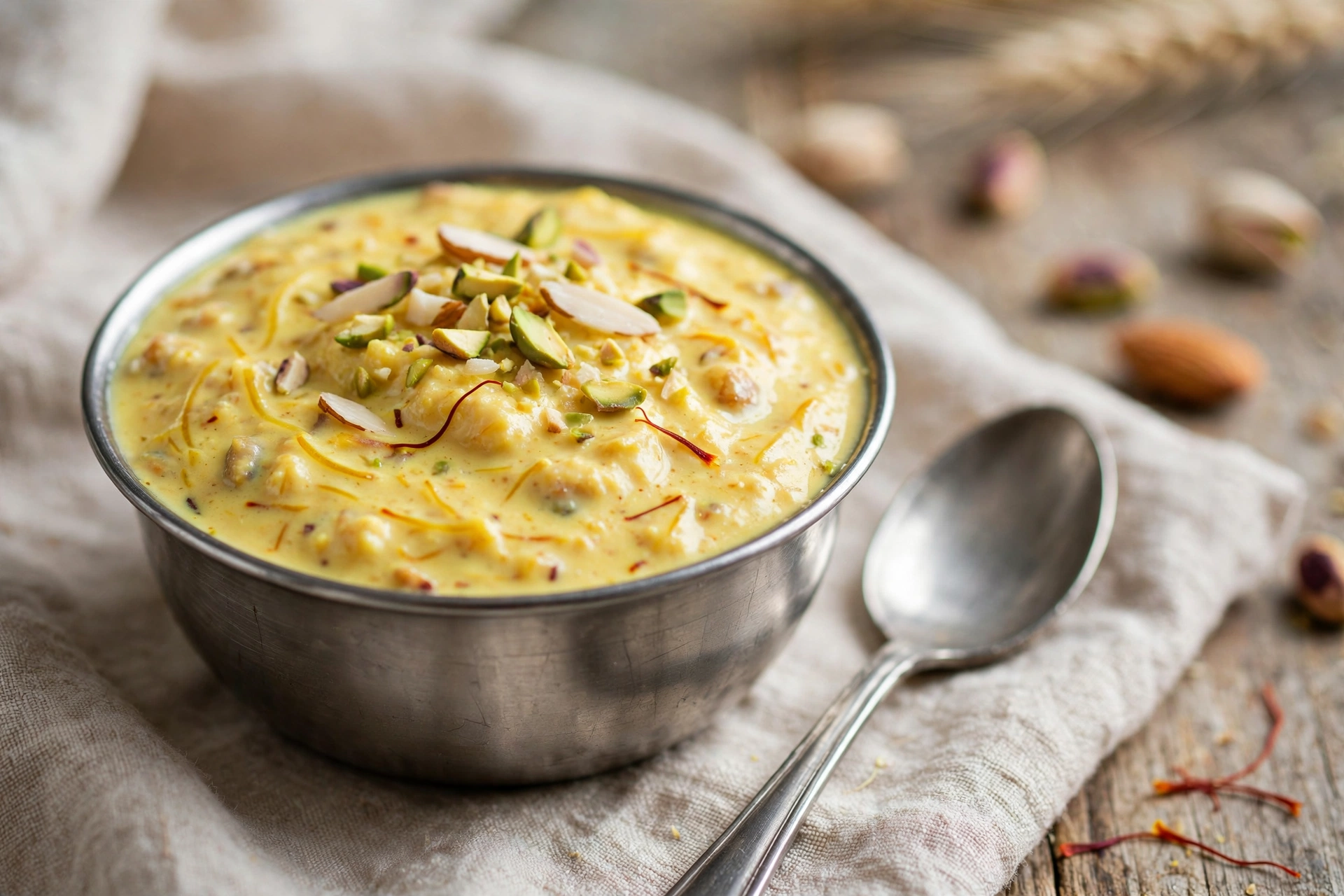
Basundi is Gujarat’s beloved milk dessert — full-fat milk simmered slowly until it thickens into a creamy, golden pudding, flavoured with saffron and cardamom and topped with chopped nuts. It tastes rich but delicate, sweet but not heavy, and it is served chilled in small bowls at weddings, festivals, and Sunday dinners. One spoonful tastes like celebration.
This recipe works because the milk is reduced slowly on a low flame with regular stirring, so it thickens naturally without any cornflour or condensed milk, and because the saffron is soaked in warm milk first so its colour and flavour spread evenly. It takes patience, not skill — if you can stir a pot for 45 minutes, you can make perfect basundi. It is ideal for festivals, for guests, and for anyone who wants a traditional Gujarati sweet with just five main ingredients.
Basundi
Ingredients
- 1 litre Full-fat milk 4 cups
- 1/3 cup Sugar 65 g
- Saffron strands a generous pinch, about 15 strands
- 1/2 teaspoon Cardamom powder
- 1 tablespoon Almonds chopped
- 1 tablespoon Pistachios chopped
- 1 teaspoon Charoli (chironji) optional
- 1/2 teaspoon Rose water optional
Instructions
- Soak the saffron in 2 tablespoons of warm milk for 10 minutes.
- Boil the milk in a heavy pan, then simmer on a low flame for 35–40 minutes, stirring often and scraping the sides.
- When the milk has reduced to about half, add the sugar and the saffron milk.
- Cook for 5 more minutes, then add cardamom powder and switch off the flame.
- Cool to room temperature, then chill in the fridge for at least 2 hours.
- Serve chilled, garnished with chopped almonds, pistachios, and charoli.
Notes
Ingredients
| Ingredient | Quantity |
|---|---|
| Full-fat milk | 1 litre (4 cups) |
| Sugar | 1/3 cup (65 g) |
| Saffron strands | A generous pinch (about 15 strands) |
| Cardamom powder | 1/2 teaspoon |
| Almonds | 1 tablespoon, chopped |
| Pistachios | 1 tablespoon, chopped |
| Charoli (chironji) | 1 teaspoon (optional) |
| Rose water | 1/2 teaspoon (optional) |
| Warm milk (for soaking saffron) | 2 tablespoons |
Optional ingredients: 1 tablespoon of condensed milk for a richer basundi (reduce the sugar a little), a few dried rose petals for garnish, 1/2 teaspoon of nutmeg powder instead of cardamom.
How to Make Basundi
Step 1: Soak the Saffron
Warm 2 tablespoons of milk and pour it over the saffron strands in a small bowl. Leave it for 10 minutes. The milk will turn a deep golden colour — this is what gives basundi its beautiful colour and flavour. Do not skip this step; dry saffron added straight to the pot does not spread evenly.
Step 2: Boil the Milk
Pour the full litre of milk into a heavy-bottomed pan or kadhai. A wide pan works best, because more surface helps the milk reduce faster. Bring it to a boil on medium flame, stirring once or twice so it does not stick.
Step 3: Simmer and Reduce
Turn the flame to low. Let the milk simmer gently for 35–40 minutes. Stir every 3–4 minutes, and scrape the creamy layer (malai) from the sides of the pan back into the milk — that layer is what makes basundi thick and rich. The milk should reduce to about half, around 500 ml, and coat the back of a spoon.
Step 4: Add Sugar and Saffron
Add the sugar and the saffron milk, and stir well. Cook for 5 more minutes until the sugar has dissolved and the basundi turns a light golden colour. Do not cook it much longer after adding sugar, or it will become too thick as it cools.
Step 5: Add Cardamom and Cool
Switch off the flame and stir in the cardamom powder. If you are using rose water, add it now, off the heat, so its fragrance stays fresh. Let the basundi cool to room temperature, stirring once or twice so no skin forms on top.
Step 6: Chill and Serve
Pour the basundi into a serving bowl or small bowls, cover, and chill in the fridge for at least 2 hours. Basundi tastes best cold. Just before serving, sprinkle the chopped almonds, pistachios, and charoli on top.
What is Basundi?
Basundi is a traditional Gujarati (and Maharashtrian) sweet made by reducing milk until it is thick and creamy, then flavouring it with saffron and cardamom. It is the dessert of Gujarati weddings and festivals — served in small bowls at the end of a thali, or poured over puri as a festive treat. Unlike kheer, which has rice in it, basundi is pure reduced milk, so its texture is smooth and silky. It is also the base for other sweets: the same reduced milk, thickened a little more, becomes rabri.
Tips for Perfect Basundi
- Use full-fat milk. Toned or skimmed milk will not reduce into a thick, creamy basundi, no matter how long you cook it.
- Use a heavy, wide pan. A thin pan burns the milk, and a narrow pan takes much longer to reduce it.
- Stir and scrape the sides often. The malai that forms on the sides is the best part — scrape it back in for a rich, thick basundi.
- Keep the flame low. High heat makes the milk boil over and stick to the bottom.
- Add sugar only after the milk has reduced. Sugar added early slows the thickening and can make the basundi grainy.
- Soak the saffron first. Ten minutes in warm milk is enough for the colour and flavour to come out fully.
- Let it chill properly. Basundi thickens more as it cools — the hot basundi should still pour easily, like thick cream, not like a solid.
Variations
Kesar Badam Basundi: Add 2 tablespoons of almond paste with the sugar. It makes the basundi richer and nuttier, and a little thicker.
Mango Basundi: Once the basundi has cooled, stir in 1/2 cup of mango pulp. It is a summer favourite — serve it chilled with puri.
Chocolate Basundi: Add 2 tablespoons of cocoa powder with the sugar for a modern twist that children love. Garnish with chocolate shavings.
Rose Basundi: Add 1 teaspoon of rose water and a few dried rose petals. The flavour is floral and light, perfect for a wedding dinner.
Vegan Basundi: Use full-fat coconut milk or almond milk and reduce it the same way. The taste is different, but the method works — add the sugar and saffron as usual.
What to Serve with Basundi
Serve basundi with:
- Puri — hot, puffed puris dipped in chilled basundi is the classic festive pairing
- Mohanthal — another Gujarati sweet for a festival dessert plate
- Laapsi — serve both sweets together at a wedding thali
- Khajur Paak — a dry sweet that balances the creamy basundi
- Undhiyu — basundi is the traditional sweet served after an undhiyu thali in winter
- Gujarati kadhi — part of the same festive thali
Storage Tips
- Room temperature: Do not keep basundi out for more than 2 hours. Milk sweets spoil quickly in warm weather.
- Fridge: Store in a covered container for up to 3 days. It thickens a little more in the fridge — stir in a spoonful of cold milk if it gets too thick.
- Freezer: Do not freeze basundi. It splits and turns grainy when thawed.
- Reheating: Basundi is served chilled, so no reheating is needed. If it has set too thick, let it sit at room temperature for 15 minutes and stir well.
Nutrition
| Nutrient | Amount (approx. per serving) |
|---|---|
| Calories | 260 kcal |
| Protein | 8 g |
| Carbohydrates | 30 g |
| Fat | 12 g |
| Fibre | 1 g |
Basundi is rich in calcium and protein from the milk, and the nuts on top add healthy fats and a little extra protein. It is a festive sweet, so it is higher in sugar and fat than an everyday dessert — enjoy it in a small bowl, the way it is served in Gujarat.
Frequently Asked Questions (FAQs)
1. What is the difference between basundi and rabri?
Both are reduced milk, but rabri is reduced further until it is very thick, with layers of malai, and it is usually served as a topping. Basundi is thinner and pourable, served in a bowl as a dessert on its own.
2. Why is my basundi not thickening?
You may be using toned milk, or not cooking it long enough, or on too high a flame. Use full-fat milk, keep the flame low, and give it the full 35–40 minutes. It also thickens more as it cools.
3. Can I make basundi with condensed milk?
Yes, for a quicker version. Use 500 ml of milk and 1/2 cup of condensed milk, and reduce the sugar to 2 tablespoons. Simmer for 15–20 minutes instead of 40. The taste is close, but the slow version is richer.
4. How long does basundi stay fresh?
Up to 3 days in the fridge in a covered container. Do not leave it at room temperature for more than 2 hours.
5. Can I make basundi ahead for a party?
Yes, it is best made a day ahead. Cook it, cool it, and chill it overnight. The flavour gets better, and you only have to garnish it before serving.
6. Is basundi gluten-free?
Yes, the classic recipe has no wheat or flour in it at all. Just check that your cardamom powder and saffron are pure, with no added flour.
7. Why did my milk burn at the bottom?
The flame was too high, or the milk was not stirred often enough. Use a heavy-bottomed pan, keep the flame low, and stir every 3–4 minutes, scraping the bottom as well as the sides.
8. Can I use toned milk for basundi?
You can, but the basundi will be thin and will take much longer to reduce. Full-fat milk is strongly recommended — it is the whole point of the dish.
9. What do you serve with basundi?
Chilled basundi in a small bowl, with hot puris for dipping. It is also served at the end of a Gujarati thali, after the main course.
10. Is basundi the same as kheer?
No. Kheer has rice cooked in the milk; basundi is milk reduced on its own, with no rice. Basundi is smoother and silkier, and it is flavoured mainly with saffron and cardamom.
Conclusion
Basundi proves that the best Gujarati sweets are often the simplest — milk, sugar, saffron, and patience. Slow the milk down, stir it with care, chill it well, and you have a dessert that has graced Gujarati weddings for generations. Make it for your next festival, serve it cold with hot puris, and watch it disappear.
About the Author
Vaishali Soni loves cooking traditional Gujarati food at home and sharing tested, step-by-step recipes that work for beginners. She writes Gujarati Food Recipes with Beena Soni. Try this recipe and tell us in the comments how it turned out.